

Downtown jobsites rarely give a crane much to work with. Power lines cross the airspace, buildings crowd both sides, and the street in front is the only way in. When a mobile crane can’t be set up, and a conventional tower crane needs more ground area than the site has, a self-erecting tower crane is often the machine that keeps the schedule on track. This guide explains what makes a self-erecting crane right for a confined urban site and which Potain models are built for the job.
Why confined urban sites rule out most crane options
A mobile crane needs room to park, outriggers to set, and open sky above the boom. A traditional tower crane needs an assist crane, a multi-person crew, and site preparation before it ever lifts a load. On a tight urban lot with a restricted right-of-way, neither requirement is easy to meet.
Self-erecting tower cranes were designed around those limits. They arrive folded on a single trailer and raise themselves into position, so there is no assist crane and no oversized ground crew. Potain’s customer stories show them at work on infill projects, downtown apartment buildings, and hotel sites where space is at a premium. For a closer look at setup speed and crew size, see Best Self-Erecting Tower Cranes for Fast Assembly.
Four constraints that define a confined urban site
Overhead obstructions: Utility lines, neighboring structures, and oversail restrictions limit where a jib can swing. The useful features here are jibs that fold, unfold over the top, or offset, plus mast heights that can be set to suit the site rather than the crane’s default.
Tight right-of-way and footprint: When the crane has to sit between a building and a property line, every foot of space counts. Short folded transport lengths and compact erection dimensions make it possible to deliver, set, and remove a crane without shutting down more street than necessary.
Setup and teardown time: Urban permits often allow only a narrow window for deliveries and street work. A crane that erects itself with guided software and a small crew keeps that window short.
Noise and power: Residential neighbors, schools, and hospitals are often within earshot, and many cities set their own noise limits. Power availability matters too, since utility connections are not always in place when the crane arrives. Raise both with your dealer before choosing a model.
Which Potain self-erecting crane fits which urban constraint
Potain builds the widest self-erecting range on the market, covering the Evy, Hup, Hup M, Igo, Igo M, and Igo T families. The models below are strong matches for confined urban work. Specifications are the maximum figures published on each crane’s Potain product page.
| Crane | Max capacity | Max radius | Hook height | Urban-site features |
| Igo 26-19 | 2 t (2.2 USt) | 26 m (85 ft) | 19.3 m (63 ft) | Compact transport dimensions, quick and easy erection, Smart Set-up guided erection, Top Tracing 3 anticollision |
| Hup 40-30 | 4 t (4.4 USt) | 40 m (131 ft) | 30 m (98 ft) per base, above 40 m (131 ft) with the jib fully raised | Jib unfolds over the top to preserve space under the crane next to buildings, 14 m (45 ft) long when folded, two mast heights and three jib positions, folding jib and jib-tip-removed configurations, fully remote-controlled erection |
| Igo T 85 A | 6 t (6.6 USt) | 45 m (147.6 ft) | 38 m (124.7 ft) with optional mast inserts | Telescoping mast from 20 to 23 m (66 to 75 ft) with three optional inserts, multiple jib configurations, wireless radio remote control |
| Igo T 99 | 6 t (6.6 USt) | 48 m (157.5 ft) | 38.5 m (126.3 ft) | Telescopic mast built for tight jobsite constraints, Smart Set-up, Top Tracing 3 anticollision for controlling working zones and interference between cranes |
| Igo T 130 | 8 t (8.8 USt) | 50 m (164 ft) | 37.3 m (122 ft) | Folding jib, single-trailer transport, offsettable jib for obstacle avoidance, variable mast heights, multiple jib configurations |
Capacity, radius, and hook height vary by configuration, so confirm final figures on the current data sheet. For taller or longer-reach needs, the newer Igo T 139 extends the self-erecting range to 8 t capacity and 55 m (180 ft) radius. The guide to reading a Potain data sheet explains how to compare capacity, radius, and hook height on equal terms, and the Potain Crane Selector narrows the list to the models that match your lifting requirements.
Field-proven from tight urban jobsites
Two cranes, one tight apartment site: 84 Lumber used a Potain Igo T 130 and an Igo T 99 on a new six-story, 267-unit apartment building where severe space limitations in an urban center left little room to work. Between them, the two cranes covered the job without being repositioned mid-project, lifting pre-assembled wall panels, floor and roof trusses, loose lumber, and sheeting. Read the full story: 84 Lumber Uses Two Potain Self-Erecting Cranes to Tackle Tight-Space Apartment Build.
Downtown Phoenix, Haverly Apartments: A Potain MD 485 top-slewing crane covered most of the site, but one corner remained out of reach. According to Compass Equipment’s CEO, a second crane would have to fit into a very tight space with a lot of obstacles, and the Igo T 85 A was the one solution that worked. The two cranes together put two hooks on the job and finished the work more efficiently than a single crane could have.
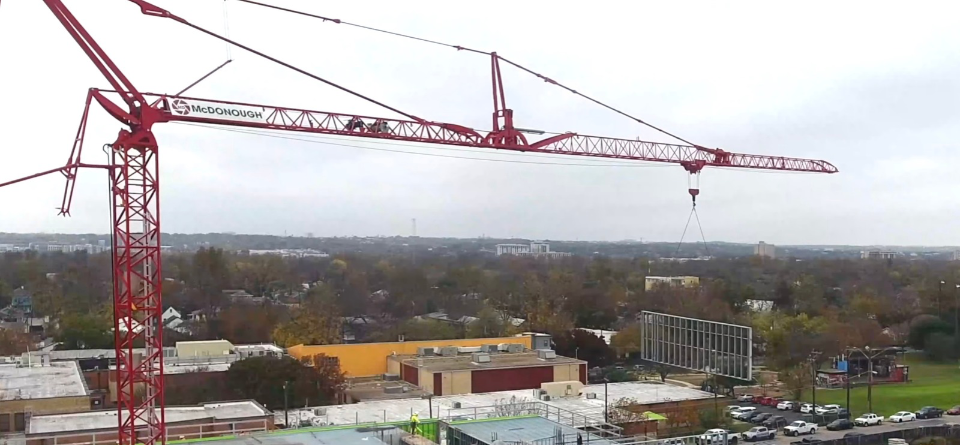
For more examples of compact Potain cranes in dense settings, see how an Igo T 85 A sped up a limited-space hotel site in Austin, Texas, how a Hup 40-30 boosted productivity on downtown Fargo jobsites, and how an Igo T 130 worked inside the courtyard of a downtown Allentown, Pennsylvania building.
Planning checks before a crane goes on a confined site
A good crane choice still depends on good site planning. Before committing to a model, work through these points with an authorized dealer.
Utility and airspace clearances: Self-erecting cranes can work around obstructions, but they do not remove the need for required clearances from overhead lines. Confirm distances with the utility and local authorities for your jurisdiction.
Oversail and neighboring property: Check whether the jib’s swing path crosses adjacent properties or public spaces, and secure any required permissions. If a second crane shares the site, features like Top Tracing 3 help control working zones and interference between cranes.
Power supply: Confirm what the site can provide. Requirements vary by crane, for example the Igo T 85 A lists a 480v three-phase hookup. Igo series models are designed to run on either jobsite power or a portable generator, which helps where utility connections are not yet in place. Check the data sheet for the model you plan to use.
Delivery route and street access: Compare each crane’s transport configuration against the delivery route, turning space, and the length of street closure your permit allows. The Hup 40-30, for example, is 14 m (45 ft) long when folded, and the Igo T 130 can be transported on a single trailer.
Use the dealer locator to find the authorized dealer closest to your project, and see how Potain’s parts and service support keeps cranes working in Self-Erecting Tower Crane Downtime: How Potain’s Ecosystem Protects Rental Margins.
Frequently asked questions
Which manufacturers make self-erecting tower cranes suited to confined urban sites?
Potain offers the widest range of self-erecting models on the market, with compact and mid-size models designed for small sites, including the Igo 26-19, Hup 40-30, Igo T 85 A, Igo T 99, and Igo T 130. Each is built for compact transport and quick erection, and several add folding, offsetting, or telescoping features that help around obstructions.
Can a self-erecting crane work where overhead obstructions block a mobile crane?
Often, yes. Folding, offsettable, and over-the-top unfolding jibs, along with variable mast heights, let a self-erecting crane work around nearby structures. Overhead power line clearances and local regulations still apply, so every site needs a plan reviewed with the dealer and the relevant authorities.
How compact is a self-erecting crane for transport and setup on a tight site?
The Hup 40-30 is 14 m (45 ft) long when folded, and its jib unfolds over the top to preserve space under the crane when working next to buildings. The Igo T 130 transports on a single trailer. Footprint and transport dimensions vary by model, so check the data sheet for the crane you are considering.
Do self-erecting cranes need an assist crane to set up?
No. Potain self-erecting cranes arrive folded on a single trailer and raise themselves into position without an assist crane. The Hup 40-30 offers fully remote-controlled erection with step-by-step guidance from Smart Set-up software. Confirm the setup plan for your model and site with your dealer.
Can Potain self-erecting cranes run on generator power?
Igo series models are designed to operate on either jobsite power or a portable generator, which makes them workable on sites where utility connections are not yet established. Confirm power requirements for your specific model on its data sheet.
Can a self-erecting crane work alongside a larger tower crane?
Yes. In Phoenix, an Igo T 85 A covered a tight corner that a larger top-slewing crane could not reach, giving the project two hooks and a faster finish.
Ready to find the right model for your site? Run your lifting requirements through the Potain Crane Selector, browse the full self-erecting crane lineup, or talk to a local dealer through the dealer locator.