

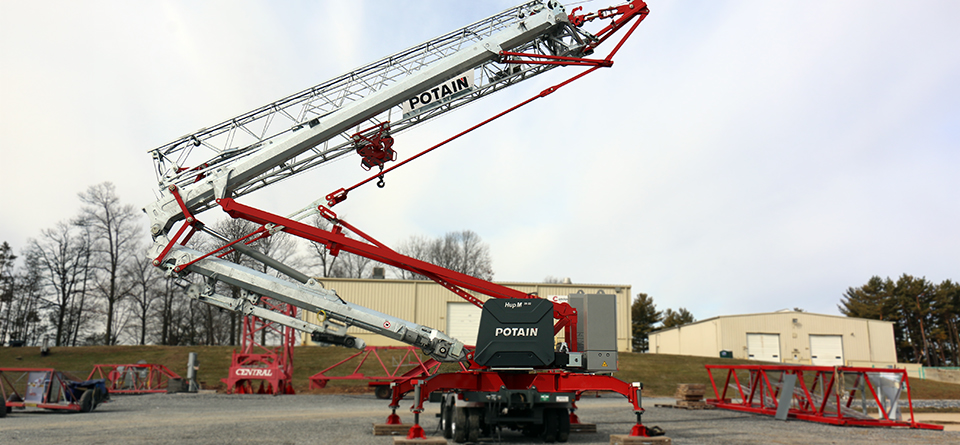
If mobilization cost is threatening your margin before the first lift, the crane choice is worth a hard look.
Traditional tower cranes require an assist crane, a multi-person crew, days of site prep, and a logistics chain that can unravel quickly. Potain self-erecting cranes were built to cut through all of that. They arrive folded on a single trailer, raise themselves into position, and are operational in hours, not days. No assist crane. No oversized ground crew. No morning lost waiting on a setup that should have finished yesterday.
But “self-erecting” covers a wide range of machines. The right model depends on your hook height requirements, site constraints, load capacity needs, and how lean you need to run the setup crew. This guide walks through the Potain self-erecting lineup and ranks each series by what matters most on fast-paced job sites.
What Fast Assembly Actually Means in This Class
Before comparing models, it helps to define the benchmark.
- Assembly time is the clearest measure. The best self-erecting cranes in the Potain range are fully operational in under two hours (transport to lifting in the same morning) with no overnight setup and no standby crew waiting on parts.
- Crew size is the variable that changes project economics most directly. A self-erecting crane that still needs five people to erect hasn’t solved the problem. Several models in the Potain lineup can be erected and commissioned by one to two people, with no assist crane required at any point.
- Transport configuration determines how quickly a machine moves between sites. Single-trailer transport with folding jibs and compact mast systems keeps haul costs low and repositioning fast across a multi-site fleet.
Every Potain self-erecting crane meets all three criteria. The differences between series come down to how far each model pushes each variable.
The Potain Self-Erecting Lineup at a Glance
Potain offers the widest range of self-erecting tower cranes on the market. The current lineup spans six series: Evy, Hup, Hup M, Igo, Igo M, and Igo T. Each was developed around a different set of jobsite constraints. That breadth matters because a crane matched to a wood-frame townhouse isn’t the right tool for a confined urban renovation, and buying the wrong machine for the work is expensive.
Browse the full self-erecting crane model lineup to compare specs across every series. All models share the same remote control platform and control logic, so operators familiar with one series move to another without retraining from scratch.
1. Igo M Series: The Lowest Crew Floor in the Class
Best for: Contractors who need single-operator erection on residential and light commercial sites.
The Igo M is where mobilization cost drops furthest. Unfolding and commissioning can be completed by one person. That’s a specific design outcome, not a marketing claim; the hydraulic mast system and pre-rigged jib are built to eliminate the need for a second pair of hands during erection. When labor availability is tight and crew time is expensive, the Igo M removes a constraint that affects every other configuration in this category.
The Igo MA 21 is the larger model in this series, suited to residential and low-rise builds where steady repeat lifts, such as lumber bundles, roof trusses, and pallets of material, define the day’s work. It arrives compact for transport, raises itself into working position, and covers a wide work area from one central setup point. The newest addition to the series, the Igo M 24-19, measures just 11.83 m in its folded position and erects in under 30 minutes using Potain’s Smart Set-Up software.
- Assembly speed: Among the fastest in the Potain range, taking under 30 minutes for the Igo M 24-19
- Crew requirement: One person; no assist crane
- Transport: Single trailer; 25 kph tow bar, 80 kph tow bar, or fifth-wheel options
- Standout model: Igo M 24-19 (single-operator erection benchmark)
2. Igo T Series: Self-Erecting Performance at Conventional Tower Crane Heights
Best for: Multi-story residential and urban infill projects where hook height and capacity push beyond what standard self-erecting models cover.
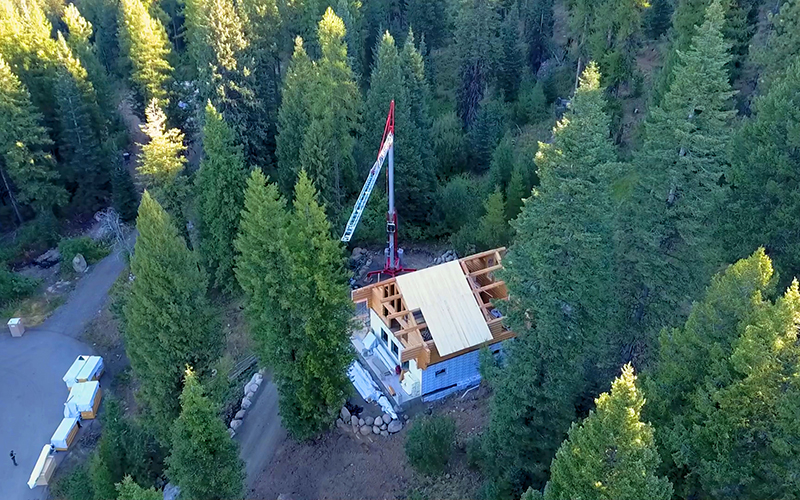
The Igo T series uses a telescoping lattice mast to reach hook heights that would typically require a conventional tower crane, all without the crew, the assist crane, or the setup timeline that comes with one. All models transport on a single trailer, self-erect without external equipment, and operate via remote control from ground level.
The Igo T 85 A handles up to 13,000 lbs and reaches 108 ft under hook, making it a direct replacement for forklifts and boom lifts on wood-frame projects. Optional mast inserts extend the telescopic lattice to 125 ft when the job demands it. The anti-load-swinging system and 360-degree rotation make it especially effective on confined urban sites where precision matters and space for repositioning doesn’t exist. Read how Frana Companies used the Igo T 85 A on a Minnesota apartment complex to see it at work on a real multi-unit build.
The Igo T 99 builds on that platform with a 6.6 USt maximum capacity and 157 ft of reach across six available jib lengths, maintaining the same compact transport footprint the Igo series is known for. Three additional mast sections provide seven working heights between 67 and 126 ft.
The Igo T 130 is the largest crane in the Potain self-erecting range. With a 105 ft working radius, a 6 USt maximum capacity, and a folding jib that keeps transport dimensions manageable, it covers multi-story residential work that sits at the upper end of what a self-erecting crane can handle. Single-trailer transport is standard.
- Assembly speed: Operational in hours from arrival
- Crew requirement: Small crew; no assist crane
- Transport: Single trailer, folding jib
- Standout model: Igo T 130 (top of the self-erecting range)
3. Hup M Series: Self-Erecting With Autonomous Mobility
Best for: Phased builds and multi-pour sites where the lift plan changes as the structure rises and repositioning between phases is a recurring cost.
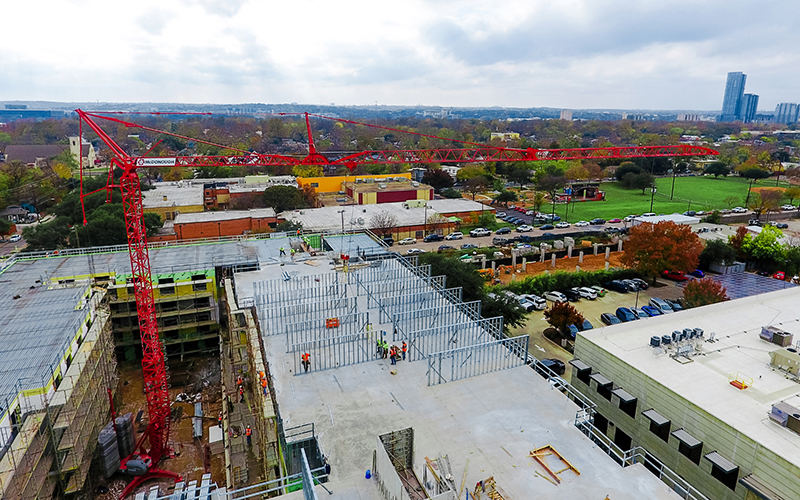
The Hup M adds autonomous mobility to the self-erecting format. It can reposition itself on site without additional equipment, eliminating the need for a telehandler, a second crew, or logistics coordination for a move that may happen multiple times across a longer project. On phased residential builds or sequential slab pours, that capability changes the economics of keeping a crane on site through the full duration of the job.
The Hup M 28-22, the largest model in the series, has a maximum jib length of 92 ft, folds into a 38 x 12 ft transport package, and can be fully erected within 30 minutes using Smart Set-Up software. It was deployed on a 192-unit apartment complex shortly after its North American debut, a project that demonstrated exactly what autonomous repositioning is worth on a large phased build.
- Assembly speed: Full erection in under 30 minutes
- Crew requirement: Minimal; self-repositioning eliminates move crew
- Transport: Compact for single trailer
- Best fit: Multi-phase builds, sequential pours, sites where the lift point shifts mid-project
4. Hup Series: Hydraulic Telescopic Mast for Residential Work
Best for: Residential and light commercial contractors who need reliable hook height with a compact footprint and straightforward operation.
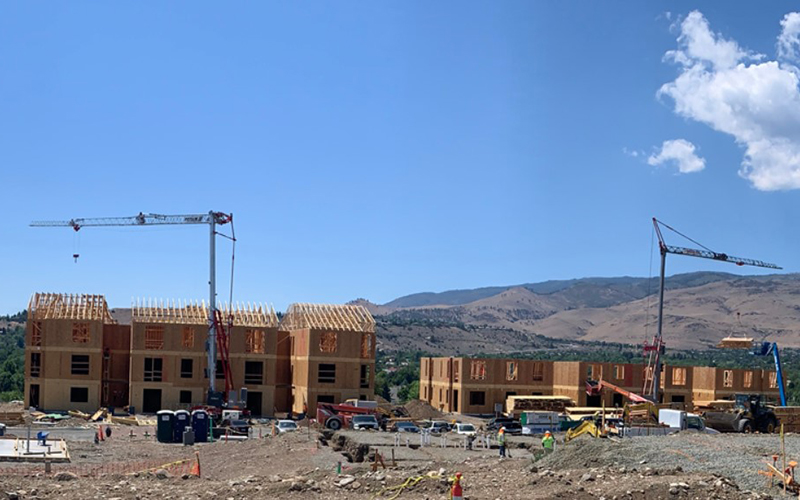
The Hup series uses a hydraulic telescopic mast to reach working height without the mechanical complexity of a lattice system. Setup is fast, the footprint is compact, and the operational profile is straightforward, which are characteristics that matter on sites where the crane operator is also managing other responsibilities.
The Hup 40-30 fits well on downtown infill and smaller commercial sites, as Dietrich Construction found when they deployed one across a series of Fargo, North Dakota jobsites. It’s a workhorse configuration: no unusual requirements, no specialized training beyond standard Potain familiarity, and a transport profile that fits a standard trailer without special permitting in most markets.
- Assembly speed: Fast; hydraulic mast erection
- Crew requirement: Small crew; no assist crane
- Transport: Compact, single trailer
- Best fit: Standard residential and light commercial work
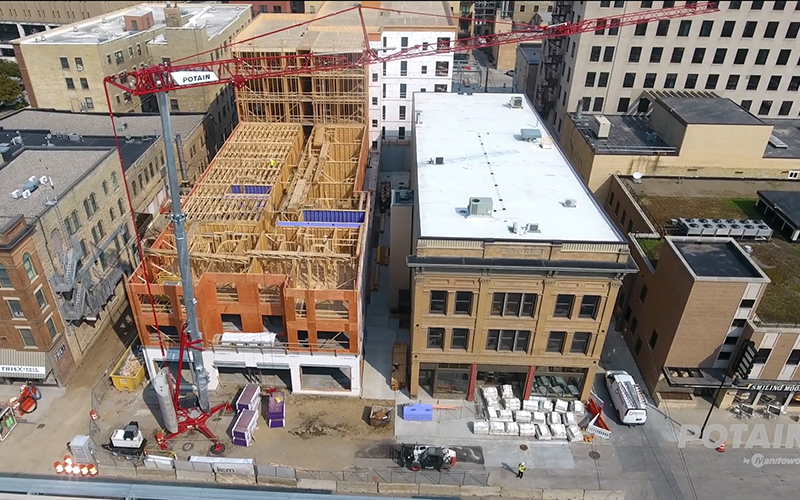
5. Igo Series: The Core Range for Mid-Range Applications
Best for: Contractors who need a reliable, versatile self-erecting crane across a wide band of residential and light commercial site types.
The Igo series is the foundation of the Potain self-erecting lineup. Models including the Igo 21 and Igo 36 cover a wide range of mid-tier applications with a compact 11.8 x 11.8 ft footprint, multiple jib configurations, and hydraulic mast erection that keeps setup simple and fast.
The Igo 21 offers long reach and excellent hook heights within that footprint, with an adjustable-spread chassis and three operational jib configurations that adapt to the specific geometry of each site. The Igo 36 adds load capacity, 4.4 USt at a 105 ft working radius, for jobs where material weights push past what the lighter models handle.
Both models can run on jobsite power or a portable generator, which matters on sites where utility connections aren’t established yet and waiting on power infrastructure would otherwise delay the crane schedule. For more on how contractors have put the Igo series to work, the Build Better blog covers real-world case studies across residential and commercial applications.
- Assembly speed: Fast hydraulic mast erection
- Crew requirement: Small crew; no assist crane
- Transport: Single trailer, multiple transport options
- Best fit: Mid-range residential and light commercial; generator-powered sites
6. Evy Series: Compact Urban Self-Erecting
Best for: Urban infill and renovation projects where access is severely constrained and footprint is the binding constraint.
The Evy series is built for jobs where getting a crane on site is the first problem. Compact transport dimensions, a small footprint, and self-erecting capability make it effective in urban environments where every dimension, like trailer width, turning radius, setup area, has to clear a tight threshold.
On inner-city renovation projects, tight infill lots, and confined-access sites, the Evy handles lifts that would otherwise require more disruptive equipment or more complex rigging approaches. It extends the Potain self-erecting range into job types where no other configuration fits.
- Assembly speed: Fast
- Crew requirement: Minimal
- Transport: Highly compact for restricted access
- Best fit: Urban renovation, tight infill, restricted-access sites

Model Comparison by Key Variables
| Series | Min. Crew | Assist Crane Needed | Single Trailer | Best Application |
| Igo M | 1 person | No | Yes | Residential; minimal crew |
| Igo T | Small crew | No | Yes | Multi-story; extended height |
| Hup M | Minimal | No | Yes | Phased builds; autonomous reposition |
| Hup | Small crew | No | Yes | Standard residential |
| Igo | Small crew | No | Yes | Mid-range; generator sites |
| Evy | Minimal | No | Yes | Urban infill; tight access |
View full specs and data sheets for every model
Frequently Asked Questions
How many people does it take to erect a Potain self-erecting crane?
It depends on the series. The Igo M series is designed for single-operator erection and commissioning. One person can unfold and put it into service. Most other Potain self-erecting models require a small crew of two to three. No model in the self-erecting range requires an assist crane.
How long does it take to set up a Potain self-erecting tower crane?
Most models are operational in under two hours from arrival on site. The Igo M 24-19 and Hup M series can erect in under 30 minutes using Smart Set-Up software. That compares to one to three days for a conventional tower crane requiring an assist crane and larger ground crew.
Can a Potain self-erecting crane replace a conventional tower crane?
For residential construction, low-rise commercial, and urban infill projects, yes, in most cases. The Igo T 130 in particular covers lift requirements that were previously only accessible with a conventional tower crane, at a fraction of the mobilization cost and setup time. Learn more on the crane overview page. On high-rise and heavy infrastructure projects, top-slewing cranes remain the right tool.
What is the largest Potain self-erecting crane?
The Igo T 130 is the largest model in the Potain self-erecting range, with a 6 USt maximum capacity and up to a 105 ft working radius, transported on a single trailer with a folding jib.
Can Potain self-erecting cranes run on generator power?
Yes. Igo series models are designed to operate on either jobsite power or a portable generator, which makes them viable on sites where utility connections aren’t yet established.
Where can I find whitepapers and spec sheets?
The Potain Build Better resources page has whitepapers, worksheets, and crane-related tools to help you evaluate which model fits your project.
The Practical Takeaway
When mobilization cost is a real line item, the crane choice affects whether a job makes money. Potain self-erecting cranes reduce the number of people required during erection, eliminate the need for an assist crane, and move between projects on a standard trailer. Across the full range, from the single-operator Igo M to the top-capacity Igo T 130, there’s a model matched to your hook height, radius, and crew requirements.
Explore the full crane lineup or contact a Potain crane expert to match the right model to your next project.
Potain is a brand of Manitowoc Cranes. Potain Build Better supports contractors across North America with crane selection, rental, and service. Read more contractor stories on the Build Better blog.